
The CWI financial crisis has prompted an emotional appeal from head coach Daren Sammy, who says Caribbean players are being asked to compete despite financial and structural disadvantages that their most powerful rivals do not face.
Speaking after the rain-affected final T20 International against India in Bengaluru on Saturday, Sammy called for greater financial support for Caribbean cricket. His remarks followed a spirited West Indies comeback from 2-0 down to draw the five-match series 2-2 against the reigning world champions.
Sammy compared India’s investment in cricket with the obstacles facing West Indies. The difference, he suggested, is between success made possible because of institutional support and performances achieved in spite of persistent disadvantages. His appeal was reported by The Indian Express and other news outlets.
But his words raise a difficult question: If West Indies players are repeatedly being asked to perform despite financial hardship, what responsibility must Cricket West Indies accept for the conditions under which they operate?
A competitive performance amid financial hardship
West Indies had much to celebrate during the India series. Captain Shai Hope produced an unbeaten 102 off 50 deliveries in the fourth T20 International in Hyderabad, while Keemo Paul claimed five wickets as the visitors leveled the contest. Hope finished the series with 261 runs and was named Player of the Series, according to the ICC’s match report.
Those performances came as the CWI financial crisis was affecting player contracts. Cricket West Indies had announced a 25% reduction in international player retainer fees, while retaining 12-month international contracts. Domestic player retainers were shortened from 12 months to seven months.

The 2026 men’s Super50 competition and certain women’s regional competitions were suspended or restructured as CWI sought to contain costs. These decisions affect not only professional cricketers’ income, but also the competitions that help identify and develop future West Indies players.
Sammy’s appeal should be understood in that context. In a previous Vincypowa News match report, we documented the extraordinary performances that kept the West Indies competitive in India.
CWI financial crisis: What the audited accounts show
The official CWI consolidated financial statements for the year ending September 30, 2025, reveal the scale of the challenge. Revenue fell from US$88.35 million in 2024 to US$40.89 million in 2025. The organization moved from a US$22.64 million profit to a US$28.53 million loss, while cash declined from US$17.47 million to just US$1.68 million.
Those numbers need context. The West Indies co-hosted the ICC Men’s T20 World Cup in 2024, generating approximately US$22 million in hosting fees and US$16.5 million in ticket revenue, according to CWI’s financial disclosures. Those extraordinary revenues did not recur in 2025.
It would therefore be misleading to attribute the entire revenue decline to mismanagement. Cricket income is cyclical. But that very dependence on irregular windfalls makes cash-flow planning, spending discipline and revenue diversification essential.
The same consolidated statements show that expenses from tours and tournaments rose from approximately US$36.85 million in 2024 to US$41.59 million in 2025, even as revenue fell. Accommodation costs increased from US$3.11 million to US$7.01 million, and personnel expenses from US$6.87 million to US$10.02 million.
These increases do not, by themselves, prove waste. Match schedules, touring obligations and other operational changes may explain part of them. Nonetheless, stakeholders deserve an explanation of which costs were unavoidable, which could be reduced and how CWI plans to manage the next lean financial year.
India makes millions. What does West Indies receive?
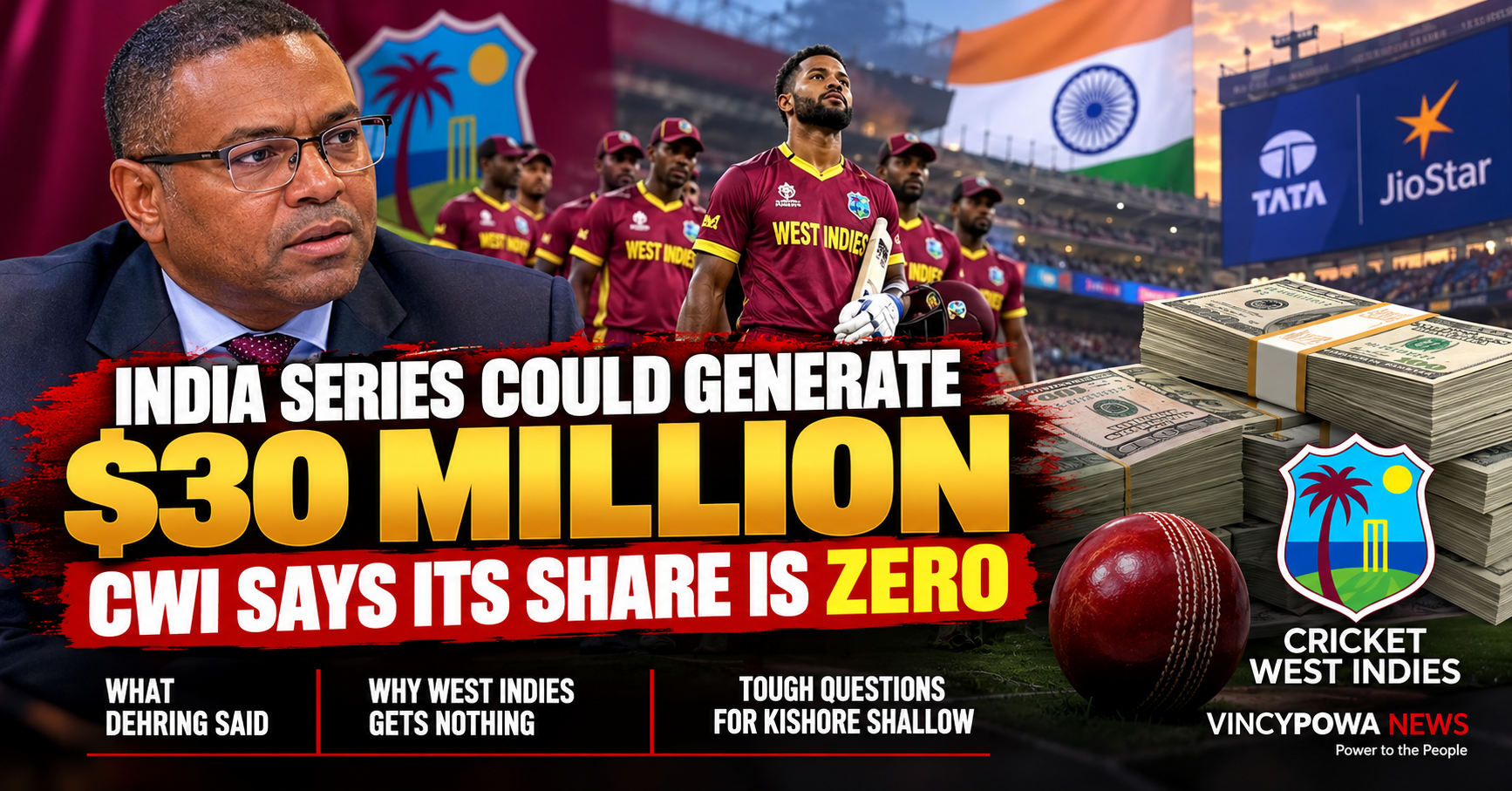
CWI chief executive Chris Dehring has raised another issue: the unequal distribution of bilateral cricket revenue. In an interview reported by Wisden, Dehring said the West Indies receives no share of host-generated commercial revenue when India hosts the Caribbean side. He estimated that a series could generate US$20 million to US$30 million for India.
The US$20 million-to-US$30 million figure is Dehring’s estimate, not an independently verified audited profit calculation. Nor does receiving no share of the host’s broadcasting receipts mean CWI earns no income from ICC distributions, sponsorship or other sources.
The underlying problem is nevertheless substantial. In the prevailing bilateral model, the host generally controls and sells rights for home matches. A cricket board with a vast domestic television market can generate revenue on a scale unavailable to a regional board representing much smaller markets.
Dehring traces a major shift in the arrangements to 1997, when touring fees gave way to a host-retains-revenue model. CWI cannot change that international framework on its own, but it can present its case to the ICC and fellow boards for a more sustainable distribution of commercial value.
Vincypowa News recently examined this same issue in India Series Could Generate $30 Million. Cricket West Indies Says Its Share Is Zero.
Kishore Shallow and the responsibility of leadership
The CWI financial crisis is also a test of leadership. President Dr. Kishore Shallow has acknowledged that the Caribbean game needs structural reform. In CWI’s 2025 Annual Report announcement, he called for renewed attention to schools, clubs and regional development pathways, while recognizing pressures from international franchise cricket.
Sammy is asking for the resources to help players compete. Shallow is arguing for a more sustainable model. Both concerns deserve attention, but the responsibility for organizational decisions rests with the CWI board and executive management, alongside its regional shareholders.
In July 2026, CWI announced an engagement with global advisory firm Teneo to review financial, operational and commercial restructuring. That initiative should be assessed on results rather than announcements.
What recommendations have emerged? What savings are expected? Which development investments will be protected? When will members and the public receive measurable evidence of progress?
CWI has also secured approval for an ICC loan facility of up to US$16 million, subject to repayment obligations and conditions. That may provide necessary liquidity, but borrowed money is not recurring operating revenue.
If players must accept reduced retainers, it is reasonable to ask whether executive and administrative costs are receiving comparable scrutiny. Those are questions of institutional accountability, not allegations of personal wrongdoing.
The CWI financial crisis puts player development at risk
CWI says the traditional regional tournament system is expensive to operate across a geographically dispersed Caribbean. Travel, accommodations, venues and administration impose costs that larger cricket economies can more easily absorb.
Yet domestic competitions are also central to identifying talent and preparing players for international cricket. Shorter contracts and fewer competitive opportunities could weaken the system on which the senior West Indies teams depend.
The challenge is to reduce costs while protecting meaningful high-performance pathways. A cheaper calendar is not necessarily a better one if it produces less cricket and fewer professional opportunities.
What must change now?
The financial disclosures offer another warning. CWI’s 2025 audited statements forecast an approximately US$26 million loss in 2026 and a potential US$8 million profit in 2027. Those are projections, not completed results. They depend on the successful execution of the organization’s financing and operating plans.
CWI should disclose clear benchmarks for commercial growth, administrative savings, competition reform and player development. Its leadership should explain how it will attract sponsors, responsibly manage borrowing and restore competitive opportunities when financially feasible.
International cricket authorities should also examine the imbalance between the commercial value generated by major tours and the compensation available to visiting teams from smaller markets.
West Indies cannot depend indefinitely on outside assistance. But it should not be expected to sustain a globally competitive international team within a financial model that rewards domestic market size above much of the value brought by touring opponents.
Sammy has made the appeal. Administrators must deliver.
Daren Sammy captained West Indies to two ICC Men’s T20 World Cup titles, in 2012 and 2016. He understands what sustained excellence demands, and his latest appeal reflects the frustration of players and coaches operating with limited financial security.
The West Indies’ resilience in India deserves praise. But resilience cannot become a permanent substitute for sound administration.
The ICC and its members have a responsibility to examine the revenue disparities facing smaller cricket nations. Regional governments and businesses can support cricket development. CWI’s leadership, meanwhile, must show how the resources already under its control are being used to strengthen the sport.
Sammy has spoken for the players. Now Kishore Shallow, Chris Dehring and the CWI board must demonstrate how they intend to build a system in which West Indies cricketers succeed because of the support they receive, rather than in spite of the obstacles they face.
Sources and further reporting
- The Indian Express: Daren Sammy calls for financial support, October 18
- Cricket West Indies: 2025 consolidated audited financial statements
- Cricket West Indies: Audited financials and annual reports
- Wisden: Chris Dehring on bilateral revenue sharing
- CWI announces engagement with Teneo
- CWI 2025 Annual Report announcement
- ICC: India and West Indies share T20I series honors
- Jamaica Gleaner: CWI spending cuts and ICC loan facility
Featured image: AI-composed Vincypowa News editorial graphic illustrating the financial figures in CWI’s published accounts. Not a documentary photograph.


Leave a Reply